- What to get from the company first
- Step 1: open the search
- Step 2: if you only have a name
- Step 3: read the results list
- Step 4: open the record
- What each license status means
- Which license covers which part of the job
- What the state search cannot tell you
- When the result should stop the deal
- Common questions
What to get from the company before you search
The search is only as good as what you type into it, so collect three things while the estimator is still in your driveway:
- The license number, for each trade. On a water loss that can mean a mold remediator, a general or building contractor for the rebuild, and the plumber, electrician or air conditioning contractor who fixes the cause. Each one holds its own license.
- The legal business name, not the name on the truck or the website. They differ more often than you would expect.
- Which part of the job each license is for. A valid license for the wrong work is not a valid license for your job.
If the company plans to do only the extraction and drying, there may be no state license number to give you, because Florida does not issue one for that work. That is normal, and it is covered in what the state search cannot tell you.
Step 1: Open the licensee search and pick "Search by License Number"
The Florida Department of Business and Professional Regulation (DBPR) keeps the public record. Open its licensee search and you get four ways in: by name, by license number, by city or county, and by license type.
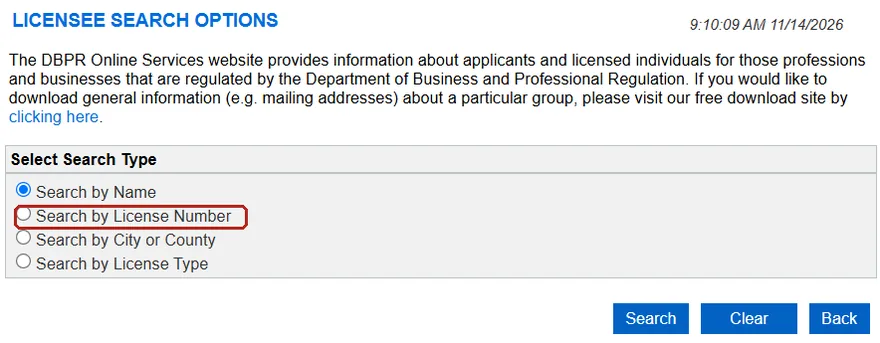
Search by license number whenever you have one. It returns one record instead of a list of similar names, which leaves no room for a near-match to fool you. A legitimate contractor can read you the number without looking it up.
Step 2: If you only have a name, narrow it by license type
Name searches return lists, sometimes long ones. Cut the list down in the Additional Search Criteria section by choosing the license category and the license type before you search.
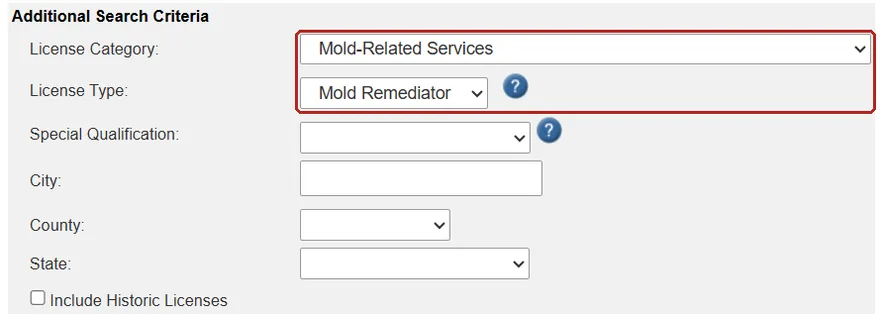
The three categories that matter on a water damage job are Construction Industry (general, building, residential, roofing, plumbing, air conditioning and mechanical contractors), Mold-Related Services (mold assessors and mold remediators) and Electrical Contractors. Type less rather than more in the name fields: a last name alone, or the first distinctive word of a company name, finds records that a full name with a typo would miss.
Step 3: Read the results list, starting with the status column
The results page says at the top that the data is current as of the moment you searched, and that clicking a name shows more information, including any complaints or discipline. Before you click anything, read the status column.
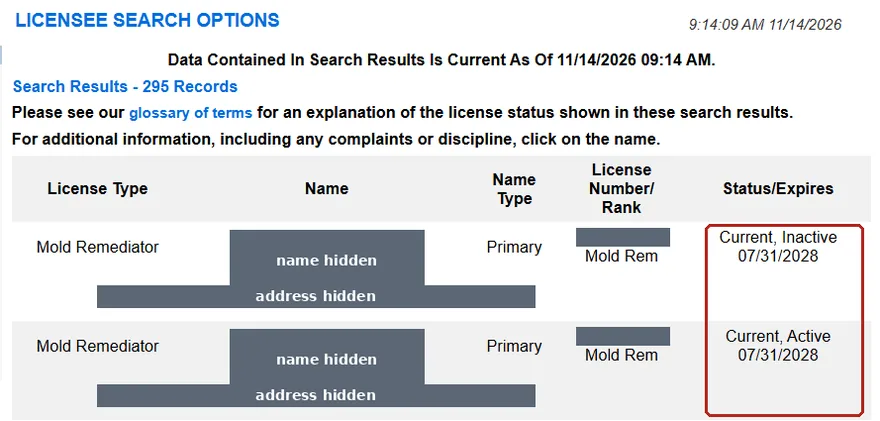
Look at the two rows. Both are mold remediators, both show "Current", and both expire on the same date. Only the second one is allowed to do the work. "Current, Inactive" means the person has met the state's requirements but is not allowed to work under that license right now. Read both halves of the status, every time.
Step 4: Open the record and check five lines
Click the name. The detail page is the record you are actually relying on.
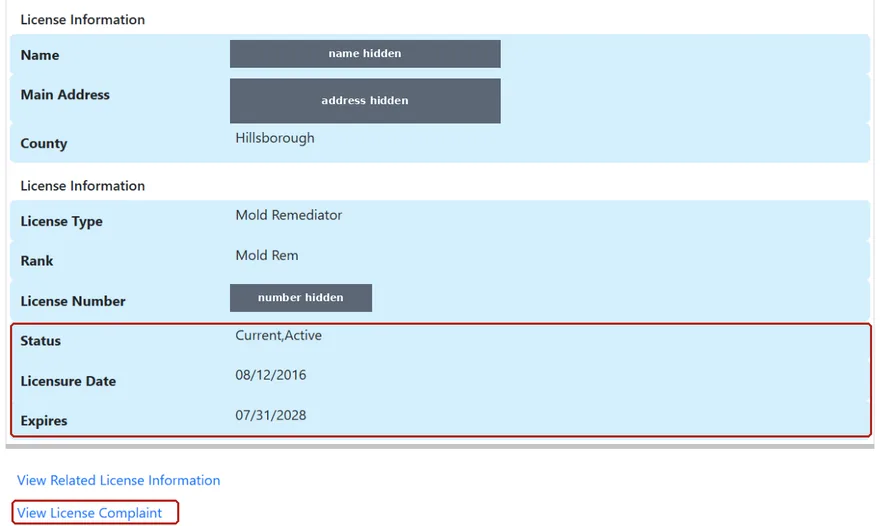
- Name. It should be the company you are hiring, or the licensed individual the company names as its qualifier. If neither matches, ask why before anything else. The View Related License Information link is where DBPR lists records connected to this one.
- License type. It has to cover the work. A roofing license does not cover plumbing, and a mold remediator license does not cover the rebuild. The table below maps the common types to the parts of a water damage job.
- Status. Current, Active, and nothing else, for a company that is about to start work.
- Expires. If the date falls before your job will end, ask about the renewal.
- View License Complaint. Click it. This is where the state shows complaints and discipline tied to the license.
If anything on the record is unclear, DBPR's Customer Contact Center is on (850) 487-1395.
What each Florida license status means
DBPR shows status in two parts: a primary status (is the license in good standing with the department?) and a secondary status (is the holder allowed to work under it?). These are the ones you are likely to meet, in the department's own terms from its glossary, with what each means for you.
| Status shown | What DBPR says it means | What it means for your job |
|---|---|---|
| Current, Active | Up to date with the department's requirements, and allowed to operate under the license | The answer you want |
| Current, Inactive | Has met the requirements but is not allowed to work under this license | Not licensed to do your job today |
| Delinquent, Invol. Inactive or Lic Expired | Has not completed a timely renewal | Not licensed to do your job today |
| Probation | Placed on probation as part of a disciplinary action or as a condition of licensure | Read the complaint record before you decide |
| Suspended | Work privileges suspended for a set period | Cannot do your job |
| Revoked | No longer meets the department's requirements to operate under the license | Cannot do your job |
| Null & Void | Failed to renew several times, and would have to reapply | Cannot do your job |
| Vol. Relinquish | Returned the license and no longer wants to hold it | Cannot do your job |
Which license type covers which part of a water damage job
On the record, the license number starts with letters that tell you the type, as in the MRSR on the mold remediator record above. The codes come from DBPR's own list. The ones you meet on a water loss:
| The work | License type | Number starts with |
|---|---|---|
| Extraction and structural drying | No state license exists for this work | — (see below) |
| Mold assessment over 10 sq ft | Mold Assessor | MRSA |
| Mold removal over 10 sq ft | Mold Remediator | MRSR |
| Rebuild: drywall, cabinets, flooring, structural repair | General, Building or Residential Contractor | CGC, CBC, CRC (certified) or RG, RB, RR (registered) |
| Roof leak repair | Roofing Contractor | CCC (certified) or RC (registered) |
| Burst pipe, supply line, water heater | Plumbing Contractor | CFC (certified) or RF (registered) |
| AC condensate line, air handler | Air Conditioning or Mechanical Contractor | CAC or CMC (certified), RA or RM (registered) |
| Wiring and panels after water exposure | Electrical Contractor | EC (certified) or ER (registered) |
Certified or registered. The first letter carries a geographic limit. A certified contractor passed the state examination and can work anywhere in Florida. A registered contractor met the competency requirements of a local jurisdiction, and Florida law says registered contractors may contract only in those jurisdictions. If the record shows a registered license, ask whether it covers the city or county your house is in.
Mold assessor and remediator are two different companies. Over 10 square feet, Florida licenses both roles, and § 468.8419 generally bars the same firm from assessing and remediating the same structure within 12 months. Expect two lookups, under two different names. The reasoning is in which Florida licenses cover which work.
What the state search cannot tell you
The DBPR record tells you whether the state recognizes a license. It says nothing about the drying crew, nothing about insurance, and nothing about whether the work will be any good. Three more checks fill most of that gap.
The drying crew: check IICRC certification instead
Florida issues no license for extraction and drying, so the useful credential is a private one: certification from the Institute of Inspection, Cleaning and Restoration Certification. The IICRC runs a public Global Locator for verifying a Certified Firm, and will confirm credentials by phone on 844-464-4272. Ask which certifications the technicians coming to your house hold, then check, rather than trusting a logo on a truck. What those certifications mean is covered in what IICRC certification actually means.
Workers' compensation: the state's own database
Florida's Division of Workers' Compensation requires construction-industry employers with one or more employees to carry workers' compensation coverage, and it counts business owners who are corporate officers or LLC members toward that number. Some owners hold an exemption for themselves instead. Both are searchable: the Division publishes a Proof of Coverage database and an Exemption Search on its website. A crew that gets hurt in your house without coverage is a problem you do not want to inherit.
Whether they are any good
No database answers that. A clean record means the company exists, in the capacity it claims, and the state currently recognizes it. That is a floor, not a recommendation. The questions that separate a competent company from an expensive one are in twelve questions to ask a restoration company.
When the result should stop the deal
- They will not give you a number. Or the number they give does not come back.
- The name on the record belongs to someone with no stated connection to the company. Ask how the license relates to the business, and expect a direct answer.
- The license type does not cover the work proposed. A roofer offering to do the mold removal, for example.
- Any status other than Current, Active on the license that covers your job.
- A registered license from somewhere other than where your house is, with no explanation.
- The same firm wants to both assess and remediate the mold.
- The complaint record shows discipline you were not told about. It is not automatically disqualifying, but you should hear the company's side before you sign rather than after.
If you come across someone working without a required license, the DBPR site has a File a Complaint option in the same menu as the search.
The license is one check of four
The state record covers the license. The IICRC locator covers the drying crew, the workers' comp database covers the coverage, and the questions in our buyer's guide cover the rest.
Water Damage Handbook is not a contractor and does not perform any work. You are always free to hire anyone you choose.
Common questions
How do I check if a contractor is licensed in Florida?
Ask for the license number, then look it up on the Florida Department of Business and Professional Regulation licensee search at myfloridalicense.com. Search by license number if you have one, or by name narrowed to the right license category if you do not. Accept the result only if the name matches the company, the license type covers the work, and the status reads Current, Active.
What does Current, Inactive mean on a Florida license?
It means the licensee has met the department's requirements for licensure but is not allowed to work under that license. For a company about to start work in your house, Current, Inactive is not good enough: the status you want is Current, Active.
Does a water damage restoration company need a license in Florida?
Not for the extraction and drying itself. Florida issues no state license for that work. It does license mold assessment and mold remediation over 10 square feet, the rebuild under Chapter 489, and the plumbing, electrical or air conditioning repair that caused the loss. For the drying crew, check IICRC certification of the technicians and workers' compensation coverage instead.
What is the difference between a certified and a registered contractor in Florida?
A certified contractor passed the state examination and can work anywhere in Florida; for most construction trades the license number starts with C, as in CGC or CBC. A registered contractor met a local jurisdiction's competency requirements and may contract only in that jurisdiction; the number usually starts with R, as in RG or RB. If the license is registered, ask whether it covers the city or county your house is in.
Can I see complaints against a Florida contractor?
Yes. Open the license record on the DBPR licensee search and click View License Complaint at the bottom of the page. The results list also notes that clicking a licensee's name shows additional information, including any complaints or discipline.
Keep reading
- How to choose a water damage restoration company in Florida: the full buyer's guide.
- House flooded? What to do in the first 24 hours: the emergency checklist.
- Water damage restoration cost: what each half of the job should cost.
- How we choose sources and stay independent
Sources
- Florida Department of Business and Professional Regulation, Licensee Search (search options, results and license record shown in the screenshots, captured 14 November 2026)
- Florida Department of Business and Professional Regulation, Term Glossary (primary and secondary license status definitions)
- Florida Department of Business and Professional Regulation, Understanding DBPR Codes (license type codes for construction, mold-related services and electrical contractors)
- The Florida Senate, Florida Statutes § 489.105 (definitions of certified and registered contractor)
- The Florida Senate, Florida Statutes § 468.8419 (separation of mold assessment and remediation)
- Florida Department of Business and Professional Regulation, Mold-Related Services FAQs (the 10-square-foot licensing threshold)
- Institute of Inspection, Cleaning and Restoration Certification, What is an IICRC Certified Firm? (Global Locator and verification by phone)
- Florida Department of Financial Services, Division of Workers' Compensation, Coverage Requirements (construction-industry coverage rule, Proof of Coverage and Exemption Search databases)
What Water Damage Handbook is, and is not. We are a consumer information site. We are not a water damage restoration contractor, we are not a licensed mold assessor or mold remediator, we are not an insurance agency, agent, broker, or public adjuster, and we do not perform any work on your home. Nothing here is insurance, legal, or engineering advice, and nothing here is a recommendation of any specific company.
How we make money. Right now, we don’t. We do not currently refer readers to anyone, sell or share personal information, or earn referral fees or commissions. If that changes, this notice and our Privacy Policy will say exactly how before it starts. You are free to hire anyone you like, including companies we have no relationship with.
Statutes, licensing requirements and published cost data change. Verify current license status through the Florida Department of Business and Professional Regulation and confirm pricing with the professional you hire.